Wednesday, October 18, 2006

In Blackwater Woods by Mary Oliver


In Blackwater Woods
Look, the trees
are turning
their own bodies
into pillars
of light,
are giving off the rich
fragrance of cinnamon
and fulfillment,
the long tapers
of cattails
are bursting and floating away over
the blue shoulders
of the ponds,
and every pond,
no matter what its
name is, is
nameless now.
Every year
everything
I have ever learned
in my lifetime
leads back to this: the fires
and the black river of loss
whose other side
is salvation,
whose meaning
none of us will ever know.
To live in this world
you must be able
to do three things:
to love what is mortal;
to hold it
against your bones knowing
your own life depends on it;
and, when the time comes to let it go,
to let it go.
~ Mary Oliver ~
(American Primitive)


Web archive of Panhala postings:
www.panhala.net/Archive/Index.html

To subscribe to Panhala, send a blank email to Panhala-subscribe@yahoogroups.com

Plant Ancestors

Unraveling Plant Ancestry Through Modern Technology

Bruce Baldin

Baldwin at work in Carson Ridge, Marin County. In addition to his research using plant DNA, Baldwin is editing a new edition of the Jepson Manual, an extensive guide to California's native and naturalized plants. (Photo by Bridget Wessa)

Since Swedish botanist Carl Linnaeus created the modern biological classification system in the mid 18th century, botanists have determined a plant's place among the wild diversity of life on the planet primarily based on its morphology, or form.

But to Bruce Baldwin, a professor of integrative biology at UC Berkeley, what a plant looks like isn't always the best indicator of its species or closest relatives. "When morphological similarity has been the sole line of evidence, it's often been misleading about evolutionary relationships," he says.

Baldwin, whose specialty is native plants of California and the Hawaiian plants that evolved from them, uses DNA testing to resolve plants' ancestry and evolution. The evidence he has unearthed shows that plant evolution can occur more rapidly than once thought, and that plants evolve with remarkable precision to fit sometimes extremely local environments. While botanists have long known that California is rich in native species, Baldwin and his students' work proves that the state's plant life is even more varied and diverse than his predecessors imagined.

Baldwin's most extensive studies have focused on Madiinae, a group of plants in the sunflower family commonly known as tarweeds. The group includes plants that look dramatically different from one another, from the more than 6-feet tall, yucca-like Hawaiian silversword to the tiny California tarweed, Hemizonella minima, often less than an inch in height. "The group has undergone tremendous change for having such a short evolutionary history," says Baldwin.

Baldwin, who is also the curator of the Jepson Herbarium at UC Berkeley, has recently used experimental and genetic methods to explore theories about the evolution of different tarweed species proposed by earlier researchers, including Jens Clausen, David Keck, and William Hiesey, a Bay Area team well known worldwide in botanical circles. The three were pioneers at their time, from the 1930s to 1950s, for incorporating genetics, ecology, and physiology into plant classification. But they lacked the tools necessary to resolve relationships with modern levels of precision.

the yellow variety of layia glandulosa

A rare, yellow variety of Layia glandulosa. The yellow variety is more closely related to L. discoidea than it is to the white plants of its own species. (Photo by Br. Alfred Brousseau, Saint Mary's College)

"There wasn't at that time a way to reconstruct genealogies rigorously, and there certainly wasn't any means of getting at the actual timing of when one species separated from another," says Baldwin.

To determine relationships between different plant species or populations, Baldwin extracts their DNA, then sequences non-coding regions that evolve rapidly enough to provide evidence of recent evolutionary change. Instead of looking for overall genetic similarity between species as in the past, which can be misleading, Baldwin reconstructs relationships based on the fewest mutational steps, or a more explicit model of DNA sequence evolution.

Through these and other techniques, he's been able to resolve questions left unanswered by earlier botanists. One of these questions is the evolutionary history of Layia discoidea ("Discoidea"), also known as rayless layia, a small annual herb.

Unlike other layias, Discoidea has a yellow bloom without rays, or showy petal-like flowers. It lives in serpentine soils, with a mineral composition toxic to many plants, in a small area of San Benito and Fresno counties, and looks so different from other tarweeds that some botanists once thought it wasn't even a member of the tribe.

Layie discoidea

Layia discoidea, a plant whose evolutionary history had long baffled botanists. (Photo credit: James R. Griffin/California Native Plant Society)

Clausen's team discovered it was a tarweed and related to Layia glandulosa ("Glandulosa"), or white layia, a ray-bearing plant found in sandy soils throughout the western United States. But the researchers weren't sure which plant came first, and thought that the rayless plant could be an evolutionary relict.

Through genetic testing, Baldwin found that Discoidea split from Glandulosa less than a million years ago. And he discovered an interesting fact about both species. Glandulosa's common name – white layia – is something of a misnomer. While most of the plants have white rays, a rare variety has yellow rays. Baldwin discovered that the rare, yellow-rayed version is more closely related to Discoidea, a separate species, than it is to the white-rayed plants in its own species. That means Discoidea underwent such rapid change that its close relationship to yellow Glandulosa was obscured, except with the aid of molecular data, Baldwin explains. Discoidea even retains a gene coding for yellow ray color, although it no longer has rays, he says.

This example "shows that evolution can proceed at very different rates and in very different ways, depending on ecological circumstances," Baldwin says. California, with its many microclimates and soils, offers a multitude of distinct environments that have shaped plant evolution here, Baldwin says. That means the state likely has many new species yet to be discovered, he adds.

But Baldwin knows if species lose their habitats, they could disappear before being discovered. "If a (species) disappears, we're losing something irreplaceable," he says. "We still aren't knowledgeable enough to say whether these plants have special ecological properties or special medicinal properties," he adds. "But we do know once they're gone, they're gone forever."

Story in Science Matters


Monday, October 16, 2006

Tallest Tree almost 400 feet --


World's tallest tree

Researchers have confirmed that a redwood named Hyperion in a remote Northern California forest is the world's tallest tree.

Steve Sillett, a forestry professor at Humboldt State University, recently climbed Hyperion and measured it at 379.1 feet, one foot taller than previously thought.

Hyperion, which grows in Redwood National Park, edged aside the previous record holder, a 370.5-foot redwood called Stratosphere Giant in nearby Humboldt State Park.

Researchers had to wait until the end of the endangered marbled murrelet's nesting season to measure Hyperion and confirm its status as the world's tallest living thing.

If it weren't for damage caused by woodpeckers at its top, Hyperion could have reached 380 feet, researchers said.

Michael Taylor and Chris Atkins, the naturalists who initially found Hyperion, said the chances of finding a taller living organism are slim because they have already searched about 95 percent of the prime habitat for big redwoods.

Officials would not pinpoint the exact location of Hyperion because they are worried that too many visitors could damage the tree's delicate ecosystem.

Picture Credit Treehugger

Saturday, August 12, 2006

Democrats missing opportunity with suspected terrorist arrest

The Bush war PR flak machine was out talking down Ned Lamont as you'd expect. Dick Cheney was on cue -- telling any reporter who still listens to him that capitalist millionaire Democrats like Lamont are just what terrorists want. Right.

But I think the Republican attacks since Joe Lieberman lost are really a cover up of Bush Cheney's (and Lieberman) support for unilateral invasion, military force, and no diplomacy.

Think about it. No matter what you say about the timing- the arrests of suspected terrorists on Tuesday are how we want to fight small bands of criminals. It is a police story. (Note to London: I would say the line "suspected terrorists" means you don't blast name and address of suspects all over the world until they have been found guilty. If some official calls you suspect, they can shoot you without consequence in Iraq, but we used to have a different definition of suspect. Today suspect appears to equal guilty which appears to be a synonym for "dead".)

The story that Bush and Cheney want to cover up is complicated -- but less about Lamont's huge win. What if it gets out that the English intelligence service is how we win the fight against small groups who want to scare the bejezus out of all of us blowing up planes.

But let's see if the democrats do anything different.

The story of arrests in England is a story democrats should be trumpeting -- it is at its heart a story about investigation, research, puzzling through evidence -- police work.

And the investigators in England are what democrats should be for -- the path not chosen by the Bush Bombs Away & chuck diplomacy team.

No bombs were dropped, thousands of people didn't get killed in a unilateral invasion by our country -- the kind of results you see in England can't happen with the Bush team -- and that is why they have to go. Lieberman is the first of many who will get the boot if Democrats make it clear they are for the type of smart intelligence gathering that secured peace we saw in England.

Joe Lieberman and the Republicans are trying to bomb their way out of a police investigation.

No sign of Osama bin Laden, yet.

Tim Colman

Friday, August 11, 2006

Dust -- a poem by Dorianne Laux

DUST

Someone spoke to me last night,
told me the truth. Just a few words,
but I recognized it.
I knew I should make myself get up,
write it down, but it was late,
and I was exhausted from working
all day in the garden, moving rocks.
Now, I remember only the flavor--
not like food, sweet or sharp.
More like a fine powder, like dust.
And I wasn't elated or frightened,
but simply rapt, aware.
That's how it is sometimes--
God comes to your window,
all bright light and black wings,
and you're just too tired to open it.

—from What We Carry by Dorianne Laux

What would Martin say?

Courage me.

''Cowardice asks the question, 'Is it safe?' Expediency asks the question, 'Is it politic?' But conscience asks the question, 'Is it right?' And there comes a time when one must take a position that is neither safe, nor politic, nor popular but because conscience tells one it is right.''

-- quote left by American soldier who fought in Iraq-- and refuses to go back.

Story on NYT via AP

Army War Objector Plans to Go to Base

By THE ASSOCIATED PRESS
Published: August 11, 2006
Filed at 9:39 a.m. ET

SEATTLE (AP) -- Shortly after returning from Iraq last year, Army Sgt. Ricky Clousing gathered a few belongings and sneaked out of Fort Bragg, leaving only a note quoting Martin Luther King.

After six months spent seeing the ''daily physical, psychological and emotional harassment of civilians,'' he was confused and disenchanted with the United States' role in the war, the 24-year-old said.

''My experience in Iraq really made me second-guess my ability to perform as a soldier and also forced me to question my beliefs in associating myself'' with the Army, he told The Associated Press on Thursday, a day before he planned to turn himself in to Fort Lewis authorities.

Officials in Fort Bragg, N.C., did not return an AP call for comment on the case. Fort Lewis officials said they did not know about Clousing's case and could not comment.

Speaking from a friend's home in Seattle, Clousing said he won't participate in what he considers to be a ''war of aggression'' that has ''no legal basis to be fought.''

Clousing sneaked out of Fort Bragg in June 2005. Beginning last fall, his lawyers said, they contacted Fort Bragg and later Fort Lewis to try to negotiate a discharge. But neither installation claims responsibility for him, said attorney Lawrence Hildes. Finally, Clousing decided to just show up at Fort Lewis.

His planned return comes just ahead of a hearing is scheduled next week at Fort Lewis for an officer charged last month with conduct unbecoming an officer and missing troop movement after he refused to deploy to Iraq. First Lt. Ehren Watada, 28, has said that his research convinced him that the war was illegal.

Watada could face nearly eight years in prison and a dishonorable discharge if convicted, his attorney has said.

Clousing, who was trained as an interrogator with the 82nd Airborne Division, deployed to Baghdad in December 2004 and was in Mosul when he said he witnessed the killing of a young Iraqi man.

His convoy had stopped to help another unit when the man came up in a vehicle, Clousing said.

''He slowed his car down, took his hands off the steering wheel and braked immediately,'' Clousing recalled. As the man started turning the vehicle around, another soldier ''fired off four to five rounds into the side of the vehicle.''

Clousing rested his head in his hands as he described helping a medic pull the injured man from the vehicle, then watching as soldiers tried to stanch his bleeding.

''The boy, looking up at me, was literally dying in front of my eyes as I looked down at him,'' he said.

Clousing said he approached unit leaders about the shooting but was treated as an inexperienced soldier who ''needed to shut up.''

Upon returning to Fort Bragg in April 2005, Clousing said he talked with military chaplains and counselors, stressing that although he did not want to be discharged from the service, he felt he could no longer support the Iraq war.

Clousing said he's not opposed to all war and because of that chose not to apply as a conscientious objector.

''My intent was solely to learn how to come to grips with what I was a part of and what had happened and what is happening,'' he said.

He sneaked out of Fort Bragg in the middle of the night, taking books, clothes and a surfboard.

He left a note on his door, with King's quote: ''Cowardice asks the question, 'Is it safe?' Expediency asks the question, 'Is it politic?' But conscience asks the question, 'Is it right?' And there comes a time when one must take a position that is neither safe, nor politic, nor popular but because conscience tells one it is right.''

Thursday, July 20, 2006

Monday, June 26, 2006

How to deal with gym rat rage -- Seattle Times Northwest Fitness Section

How do you handle conflict at your gym, Y, or any place lots of people get together for a work out -- and your neighbor smells funny, plays loud noises, gets under your skin?

Richard Seven-- Seattle Times Fitness columnist has some food for thought on Fitness Section a subject lots of people run into: conflict in the adult work out scene-- swimming, gym, any place where we have to get along -- even with testosterone Tommy's pumping aggression.

I think about these ideas a bit -- in the context of practicing being a better person. As you know, life is difficult-- and it takes a significant effort to be compassionate toward someone you initially call a jerk.


Seven's fine story gets at some ideas for solutions.

best fishes,

Timothy

Monday, June 19, 2006

Boycott Japan: Editorial from the radical Christian Science Monitor


Commentary > The Monitor's View
from the June 02, 2006 edition

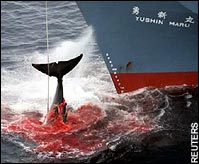
Save the whales - by not buying Japanese
The Monitor's View
Japan's export titans often get their way with their government. Right now they want senior politicians to end their controversial visits to a Tokyo war memorial that also honors war criminals - the visits are bad for business in China. But they should add this request: Don't overturn a ban on commercial whaling.

Japan has spent heavily to influence poor countries that are members of the International Whaling Commission (IWC). It just announced a fresh $410 million aid package to South Pacific nations. Its aim is to reverse a 1986 IWC ban that has allowed many whale species to begin a long, slow recovery. In mid-June, the 66 nations of the regulatory body will gather, and Japan is expected to succeed in winning the votes of many cash-poor IWC members. Overturning the ban requires a 75 percent vote, but Japan may first secure a 51 percent vote to conduct balloting in secret.

The prospect of the IWC allowing the slaughter of whale species not fully recovered has yet to raise much fuss in many antiwhaling nations. But it should, given the importance of whales in the health of oceans.

If the UN General Assembly or the US does not act soon, then a consumer boycott of Japanese products is needed. That will catch the attention of Japanese corporate leaders, who can then pressure politicians leading the pro-whaling campaign.

These politicians regard the ban as Western "culinary imperialism" aimed at Japan's tradition of eating whale meat. But the issue is conservation, not culture, and the Japanese data and arguments that many whale species are fully revived should remain suspect, and certainly not acted on in a secret IWC ballot.

It's not even clear if the Japanese people want to consume whale meat in large quantities. Less than 1 percent now eat the meat that is sold from the more than 1,000 whales Japan catches annually "for scientific research" (allowed under IWC rules). Some of the meat has ended up simply as doggie treats.

Emotions either against or in favor of whaling are usually strong. Many Japanese see hypocrisy in those who argue against the killing of such intelligent animals, but who also eat lamb or pig. Environmentalists see Japan as little concerned about nature's well-being beyond its shores. And the resurgence of nationalism in Japan - something its business chiefs sometimes oppose - may be behind this pro-whaling initiative.

Persuasion through facts and logic about the health of whale stocks are unlikely to prevail at the IWC, given Japan's long determination to overturn the ban for cultural reasons and its monied clout over weak members.

Some antiwhaling groups want the US to withhold support for a permanent Japanese seat on the UN Security Council. But that tactic is meaningless, given China's stance against Japan obtaining a seat.

Barring quick US or UN action, a temporary consumer boycott of Japanese products would carry the most certainty of saving the ban.

Forcing Japan to back down isn't a pleasant prospect. But neither is the risk of some whale species going extinct.

One side has to give, and for Japan, it's the easier give.

Tuesday, June 13, 2006

Forest Service Bails on Roadless Rules in Oregon's Biscuit/ OR Governor Goes To Court to Stop Logging


The Darth Vader side of the Forest Service is going full tilt, with Bushco's policy of "Big Bucks for Big Timber" going after big trees in roadless, salmon rich, Oregon. Let's not forget the taxpayer in this equation. You and I are subsidizing this roadless ravage policy in the millions of dollars.

Perhaps they see the 2006 elections as a potential throttle on the timber industry ravage policy-- and need to get the cut out -- biodiversity be damned?

Update here

Saturday, June 10, 2006

Peace

From a customer , Maria --

PEACE- it does not mean to be in a place where there is no noise, trouble, or hard work.

It means to be in the midst of those things and still be calm in your heart.-- Unknown

Sunday, June 04, 2006

A Poem: Man in Stream by Rosanna Warren

Man In Stream

You stand in the brook, mud smearing
your forearms, a bloodied mosquito on your brow,
your yellow T-shirt dampened to your chest
as the current flees between your legs,
amber, verdigris, unravelling
today's story, last night's travail...

You stare at the father beaver, eye to eye,
but he outstares you-- you who trespassin his world,
who have, however unwilling, yanked out his fort,
stick by tooth gnarled, mud-clabbered stick,
though your whistle vespers to the wood thrush
and trace flame-flicker in the grain of yellow birch.

Death outpaces us. Upended roots
of fallen trees still cling to moss-furred granite.
Lichen smolders on wood rot, fungus trails in wisps.
I wanted a day with cracks, to let the godlight in.
The forest is always nocturne, but it gleams,
the birch tree tosses its change from palm to palm,

and we who unmake are ourselves unmade
if we know, if only we know
how to give ourselves in this untended light.

from THE NEW YORKER which I only get for the cartoons,this meditation can be found on page 36 of the June 5th 2006 edition

Rosanna Warren writes to her Dad

His Long Home

For Robert Penn Warren, 1905-1989

I
Of Course

From lips notched in the pinebranch bled
no confession, but a clot of resin.
Such currency
in winter. No need to notch

the stream, ice-choked but still
greenly slurring
past boulders and scragwood to some ever-lapsing
period not even January

can grant. If you and I
stand, in silence, to observe
that pregnant snowcloud stalled
on Stratton's frozen stoop

it is the knowledge
that what courses between us, runs
under the rind of winter
so deep, no blade can coax it.

II
Storm, Summer

At first a numbness
gaining on the surface of the pond,
a twitching in birch and poplar leaves,
tremor in the flat, symmetrical branchtips of
balsam fir.
Then thunder surges, thudding from ridge to ridge,
a seizure of rain
sunders spiderwebs, pummels leafmold,
drowns out the true confessions of the brook.
While we cower on the porch
it passes
like a spasm,
heaves itself into the valley
over the notch.
Sky shimmers in the pond again,
breeze fondles the leaves.
We're still here. Waiting.

III
Your skin

as fragile, pale, and infinitesimally moist
as erasable bond;
your look, a startled bound
of apprehension, subsiding
into its lair.
You coil away from us:
we hunt you down.
Groping, you half-rise:
we escape, leave you there.
What intersection can we appoint
between your knowledge and ours?

IV
Two days before

you died, we saw your death
funneling in at the eye, your pupil fixed,
tiny, waking neither
to light nor to shade

so that your wisdom drained
inward where only
reverberations of our
voices fathomed:

yet you held us still
kindly, having foreknown
the sere flame tasseling
the roof beam, the palace wall

sinking but invisible
to the chorus; and in the teeth
of our denial
had already greeted

the strange man you alone
saw loitering by the porch,
had wrenched up your
emaciated smile: "Come in! Come in!"

Rosanna Warren allowed Letters to reprint this
poem in memory of her father. This is from her volume,
Stained Glass, with the permission of W.W. Norton
and Company, Inc.